
Blog
The Pain Playbook
The Pain Playbook is where recovery gets explained — not oversimplified.
Thoughtful, clinically grounded insights on pain, movement, hormones, and longevity, designed to help you understand your body, prevent setbacks, and rebuild capacity with confidence.
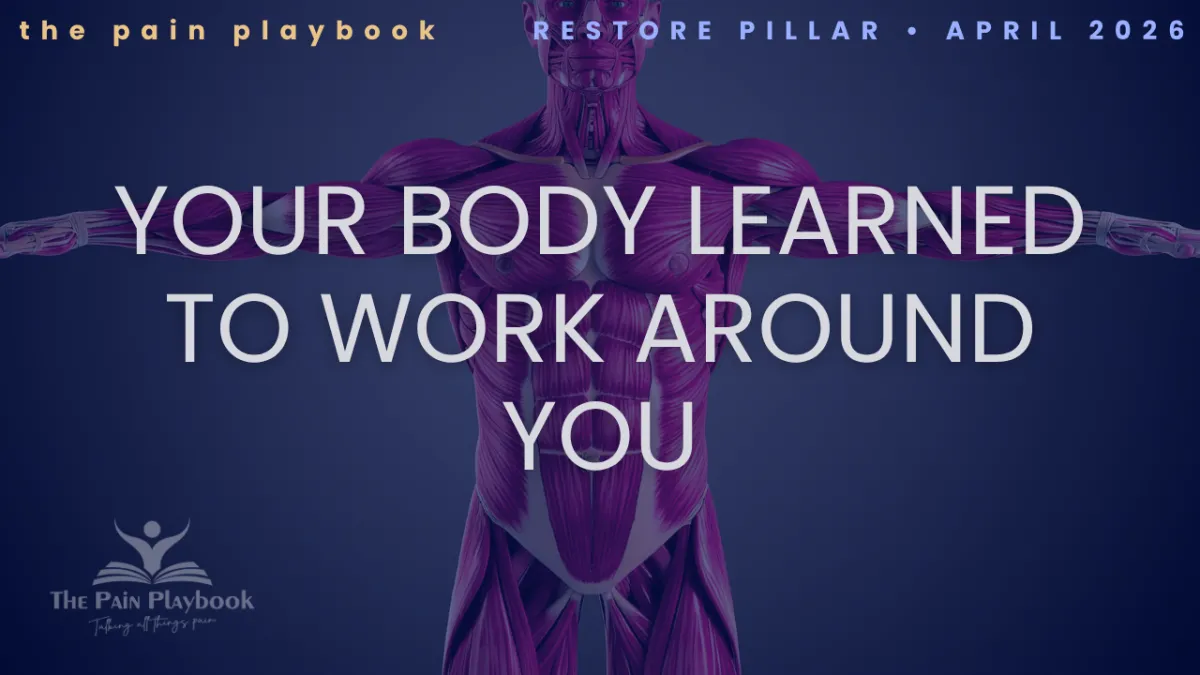
Your Body Learned to Work Around You
Your Body Learned to Work Around You
THE PAIN PLAYBOOK • RESTORE PILLAR • APRIL 2026
Here's something nobody tells you about your body:
It is brilliant at working around problems.
You have an old shoulder issue? Your body finds a way to press without loading it fully. Your hip flexors are tight? Your lower back picks up the slack. Your ankle doesn't dorsiflex well? Your knee compensates.
You keep moving. You keep training. You feel like things are fine.
And in a short-term survival sense? They are. Compensation is the body's genius. It keeps you functional when something isn't working the way it should.
But here's the part fitness culture doesn't talk about: compensation has a cost.
THE DEBT THAT BUILDS SILENTLY
Every compensatory pattern means one area is overworking to protect another. The structure doing the compensating was never designed to handle that load indefinitely. Over months and years, it accumulates stress — micro-damage that compounds quietly, with no obvious alarm until the system hits its limit.
And when it does? The injury appears in the compensating structure, not the original problem. Which is why people pull their lower back loading a weight that shouldn't be challenging. Why the "healthy" shoulder suddenly gives out. Why the knee that's been fine for years suddenly isn't.
You weren't unlucky. You were compensating — and the bill finally came due.
WHY STRENGTH TRAINING DOESN'T FIX THIS AUTOMATICALLY
This is the myth that keeps serious lifters stuck: if you build enough strength, the compensation will sort itself out.
It won't.
Strength training loads whatever patterns are already there. If the pattern is compensatory, you're strengthening the compensation. The original deficit doesn't disappear — it just becomes structurally reinforced.
You can get strong in a broken pattern. People do it all the time. Until they can't.
THE RESTORE WORK THAT ACTUALLY UNWINDS IT
Identifying and unwinding compensation patterns requires a different kind of work than strength training. It requires first making the pattern visible — which means slowing down enough to feel where load is actually going versus where it should be going.
Then it requires targeted mobility to restore the range that was originally restricted — the restriction that started the compensation chain in the first place.
Then stability work in the newly restored range — because range without stability just creates a new instability problem.
Then loading it progressively while maintaining the corrected pattern under demand.
That's not a quick fix. But it's the only sequence that actually changes the pattern instead of reinforcing it.
THIS IS ESPECIALLY IMPORTANT FOR:
Serious lifters and former competitors who've trained through discomfort for years — you've likely built significant strength on top of long-standing compensation patterns. The stronger you get in the wrong pattern, the harder it is to unwind.
GLP-1 users whose body composition is shifting — as mass changes, movement patterns shift too. Compensation patterns that were "stable" may become unstable as the load distribution changes.
Post-surgical clients who were cleared and returned to activity — surgical repair restores structure, not movement pattern. The compensations that developed pre- or post-surgery are still there unless directly addressed.
Women with hypermobility — the most overlooked piece in women's fitness. Hypermobility means you have range of motion, but often lack the stability to use it safely. Compensation develops to protect unstable joints. Strength training without addressing the underlying instability often makes it worse.
Your body isn't sabotaging you. It's been protecting you for years. The Restore phase is where you finally return the favor.
💬 What's the "healthy" part of your body that keeps taking the hit for something else?
→ Take the Body Reset Quiz™ to find your compensation pattern.
→ Or book a movement assessment Consult at bodytechnyc.com

Ready to Start?
Book Your Initial Recovery Session
60-75 minutes | Includes R3 Recovery consult
Concierge Recovery
SecondWind Program
The Pain Playbook
Contact
Privacy
Add Subtext text. Click "Edit Text" to update the font, size and more.
To change and reuse text themes, go to Site Styles.


(646) 656-1141
bodytechnyc@gmail.com