Blog
The Pain Playbook
The Pain Playbook is where recovery gets explained — not oversimplified.
Thoughtful, clinically grounded insights on pain, movement, hormones, and longevity, designed to help you understand your body, prevent setbacks, and rebuild capacity with confidence.
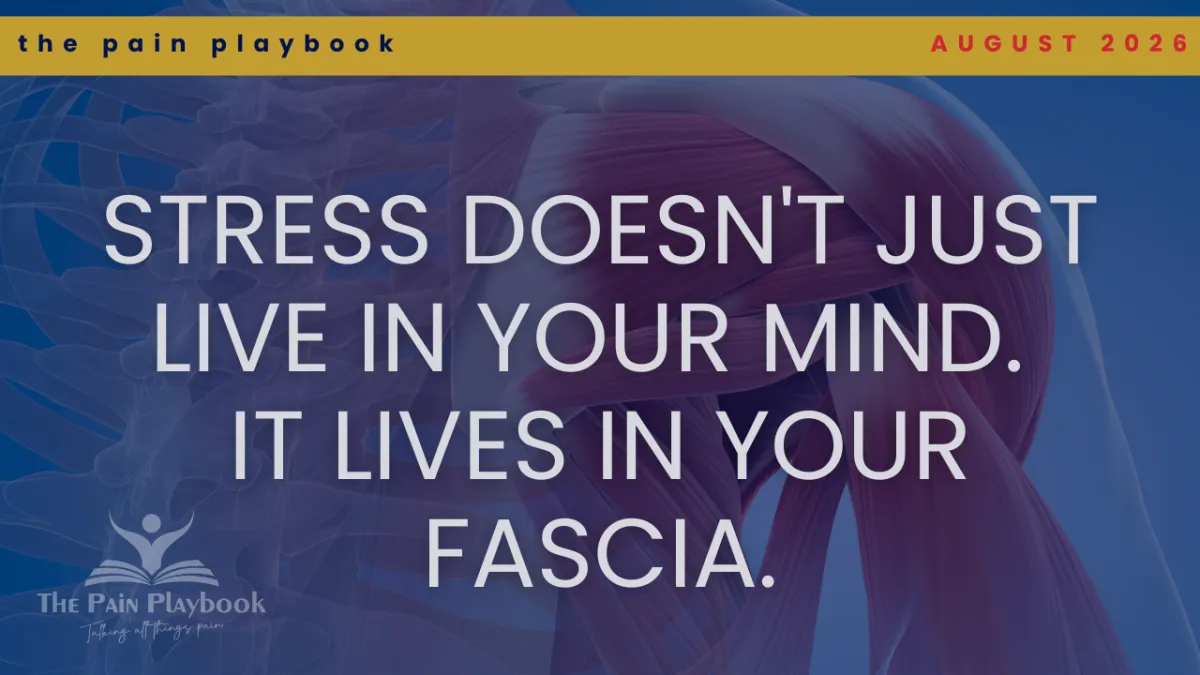
Stress Doesn't Just Live in Your Mind
Stress Doesn't Just Live in Your Mind. It Lives in Your Fascia.
THE PAIN PLAYBOOK • AUGUST 2026
You've felt it. A stressful week, and your shoulders creep toward your ears. Your jaw tightens without you noticing. Your lower back feels like it's wearing a brace it didn't ask for.
This isn't just tension you can think your way out of. It's a real, physical change in a specific tissue — your fascia — and it has a name and a mechanism.
What Fascia Actually Is
Fascia is the web of connective tissue wrapped around every muscle, organ, nerve, and blood vessel you have. It's not just packaging holding everything in place. It's alive — full of nerve endings, able to tighten on its own, and constantly reacting to what your nervous system is doing.
Under chronic stress, your body starts changing that tissue. It gets stiffer. Drier. And layers that are supposed to glide past each other start sticking instead.
The Cortisol Connection
Cortisol is your main stress hormone, and when it stays elevated, here's what it does:
Makes fascia stiffer by changing its collagen and fluid content
Turns up your nervous system's sensitivity, so things hurt that shouldn't
Slows down tissue repair because your body's too busy staying on alert
Wrecks the deep sleep your fascia actually needs to heal
This is why stress doesn't just feel like tension — it creates tension. Real, physical tightness that then feeds right back into the pain keeping your stress response cranked up. It's a loop.
Why Stretching Alone Doesn't Fix It
If this were purely a tissue problem, stretching would solve it. But when your nervous system is the one holding things tight, stretching gives you relief for an hour or two — then it's right back, because you never touched what's actually driving it.
Same goes for massage. It helps the tissue in the moment. It doesn't necessarily tell your nervous system it can stand down.
What Actually Breaks the Cycle
Manual therapy that works the fascia directly, not just the muscle
Real nervous system downregulation — not distraction, an actual shift out of fight-or-flight
Manual Lymphatic Drainage — the light, rhythmic touch is one of the best tools we have for calming your system down while working the tissue at the same time
Movement that isn't just back-and-forth — fascia likes rotation and variety, not the same straight line every time
Dealing with the actual stress, not just where it's showing up in your body
This Hits Different People Differently
If you're 40+ and you've been carrying tension for years: it compounds. The sooner you interrupt it, the less it's baked in.
If you're on a GLP-1: your body's going through real physiological stress right now from the metabolic shift. Same support applies.
If you're post-surgical: surgery and recovery anxiety both spike cortisol. Fascial work plus nervous system support helps you heal better, not just feel better.
If your hormones are shifting: estrogen normally helps regulate your cortisol response. As it drops, the same stress hits harder than it used to.
Your body isn't overreacting. It's telling you exactly what's going on.
Episode 1 Is Live
Our Pain Playbook podcast launched Saturday. If you haven't listened yet, Kat and Pedro on the couch, the origin story of the show and the R3 Method explained in plain language. Find it at youtube.com/@bodytech-nyc.
💬 Where does your body hold stress? Has anyone ever explained the mechanism to you before?
→ R3 Lymphatic Reset. MLD directly addresses fascial restriction + nervous system state

Ready to Start?
Book Your Initial Recovery Session
60-75 minutes | Includes R3 Recovery consult
Concierge Recovery
SecondWind Program
The Pain Playbook
Contact
Privacy
Add Subtext text. Click "Edit Text" to update the font, size and more.
To change and reuse text themes, go to Site Styles.


(646) 656-1141
bodytechnyc@gmail.com